Bhera is an old and ancient town in Pakistan situated midway between Lahore and Islamabad. It is a few kilometers from the salt range and is among the oldest sub-continent cities. Its archives go back thousands of years. Sher Shah Suri built the Sher Shah Suri mosque in Bhera during his stay in the city.
Before I dive in any further, please take 3 minutes to watch this video on Sher Shah Suri Mosque in Bhera.
During Sultan Mehmood Ghaznavi’s time, Bhera was a big and important city and a center of Hindu Shahis. Sultan attacked Bhera, Punjab in 1004 AD. It was famous for its wealth, skills, and learning.
Sher Shah Suri laid the modern city foundations in 1540 – 1545 AD. His army constructed a new city nearby at the present location. Bhera remained an important city during the Mughal period, and a royal mint existed here to mint coins. Sher Shah Suri constructed many forts, mosques, baolis, Sarai, and tombs in the sub-continent.
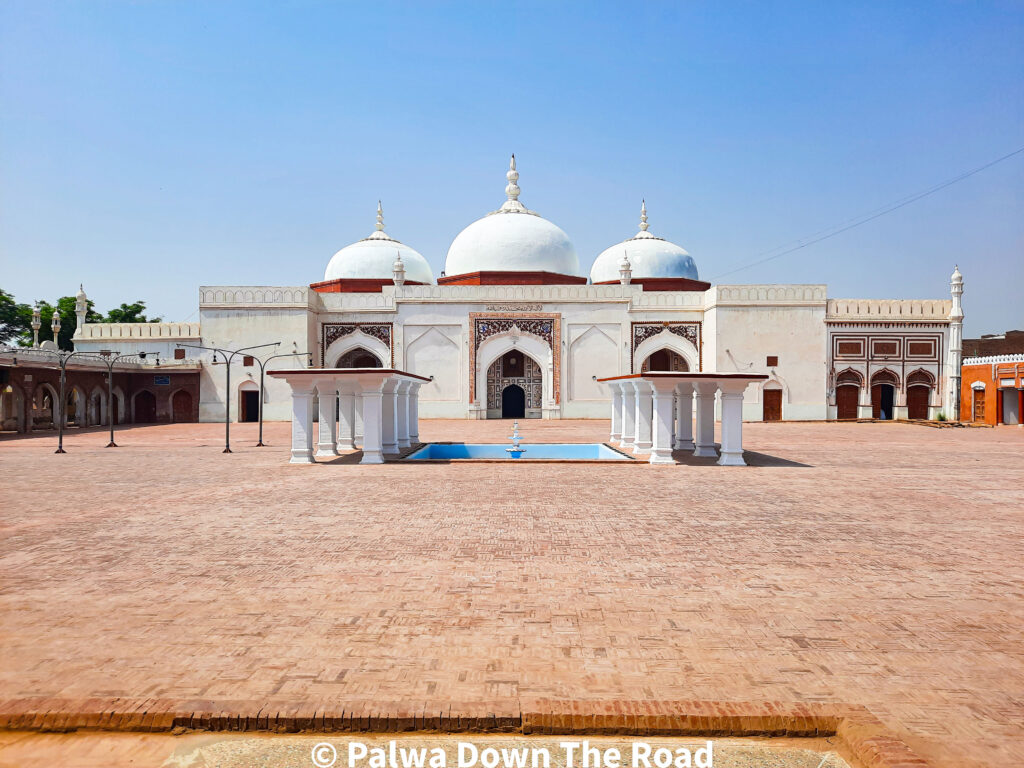
Sher Shah Suri was the first ruler of the sub-continent interested in public welfare. Many of his constructions are intact, like this shahi mosque of Bhera. This mosque is beautiful, like the Shahi mosques of Delhi, Agra, and Lahore.
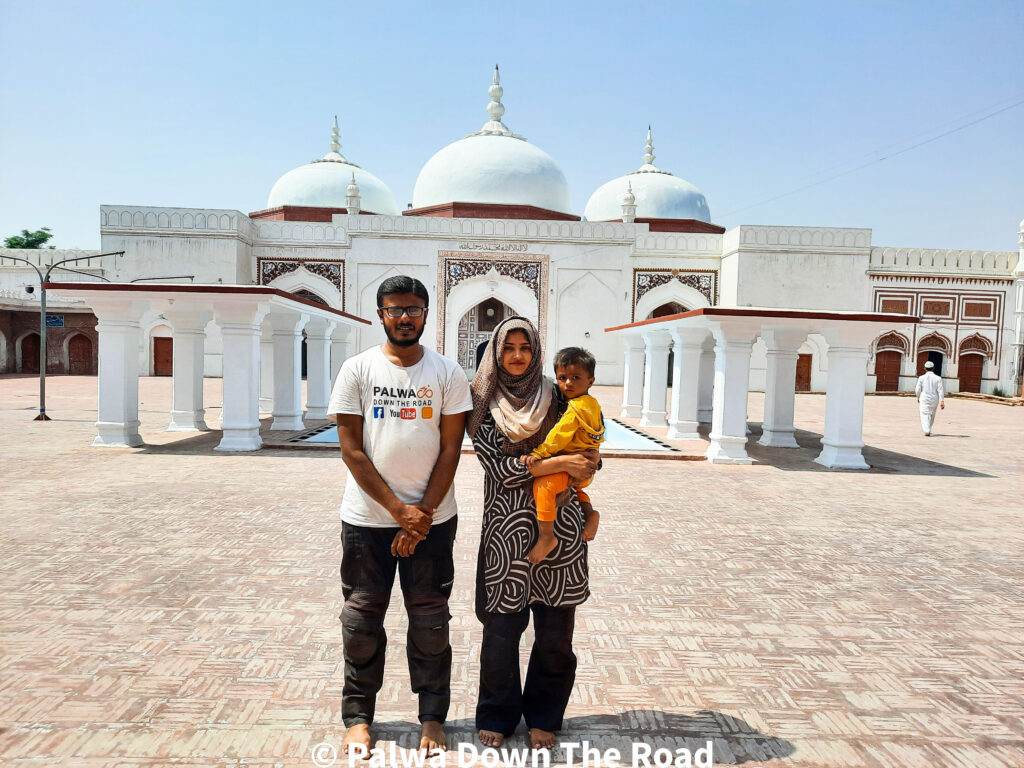
Along with my family, I came here to see the Jamia Masjid of Bhera, famous for its construction. One remains astonishing after entering the masjid. Its construction style remains unique as I have seen many such mosques.
Sher Shah Suri Mosque
During the reconstruction period of Bhera, a grand mosque was built in 1510 A.D known as the Sher Shah Suri mosque. The masjid remained in obscurity for a long time.
Sikhs conquered this vital town in 1771 AD. During the Sikh rule, the landmark mosque of Sher Shah Suri was used as a stable and a store. It was restored to Muslims in the 1850s after the British took control. This mosque’s repair and restoration work continued for a long time in several stages.
Simultaneously, the masjid was claimed and grabbed by a local Hindu zamindar. Sheikh Al-Hadith Qazi Ahmad ud Din Bugvi, Khatib of Shahi Mosque Lahore (died 1869), challenged the decision in the court, and the ownership was back to Muslims. He also repaired some parts of the mosque. He was the Qazi, Mufti, and Allama of his time.
Jamia Masjid Bhera has 44.75 kanals of land with a covered area of 20 kanals. Originally the masjid had no boundary wall but was later built after constructing side rooms. These rooms allow the teachers and students of Islamic and theology subjects to reside, coming from outstation.
During British rule, the deputy commissioner of Shahpur Punjab declared the Shahi Mosque of Bhera the most beautiful in the whole district. This mosque’s geometrical designs at the entrance are more important. This mosque is entirely different from that in Rohtas Fort, known for its artful designs and decoration. The mosque’s foundations are original, and the construction of its superstructure continued over time. The walls of this mosque are 18 to 27 feet wide.
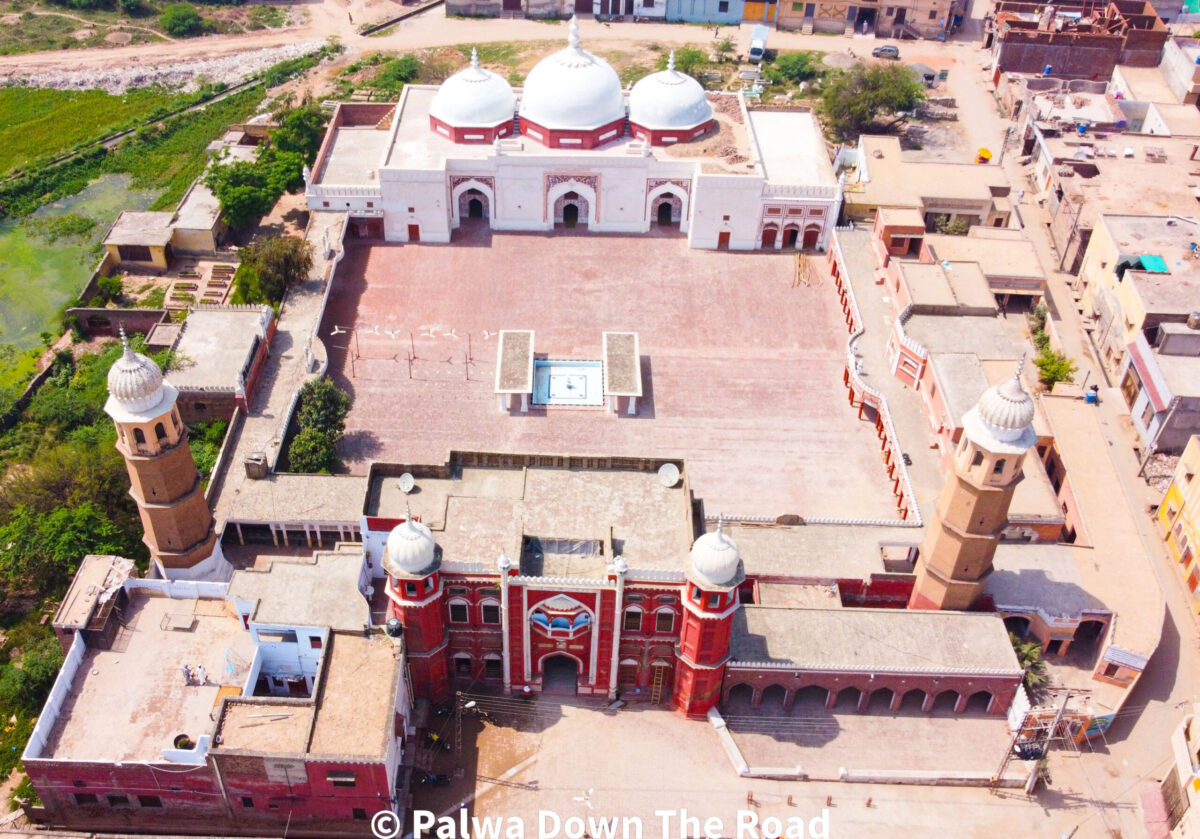
The masjid comprises a spacious courtyard with a central ground water tank for wuzu, three prominent domes, one large central and two small laterals, and two side minarets on the eastern side. Both domes and minarets have difficult stairs to access.
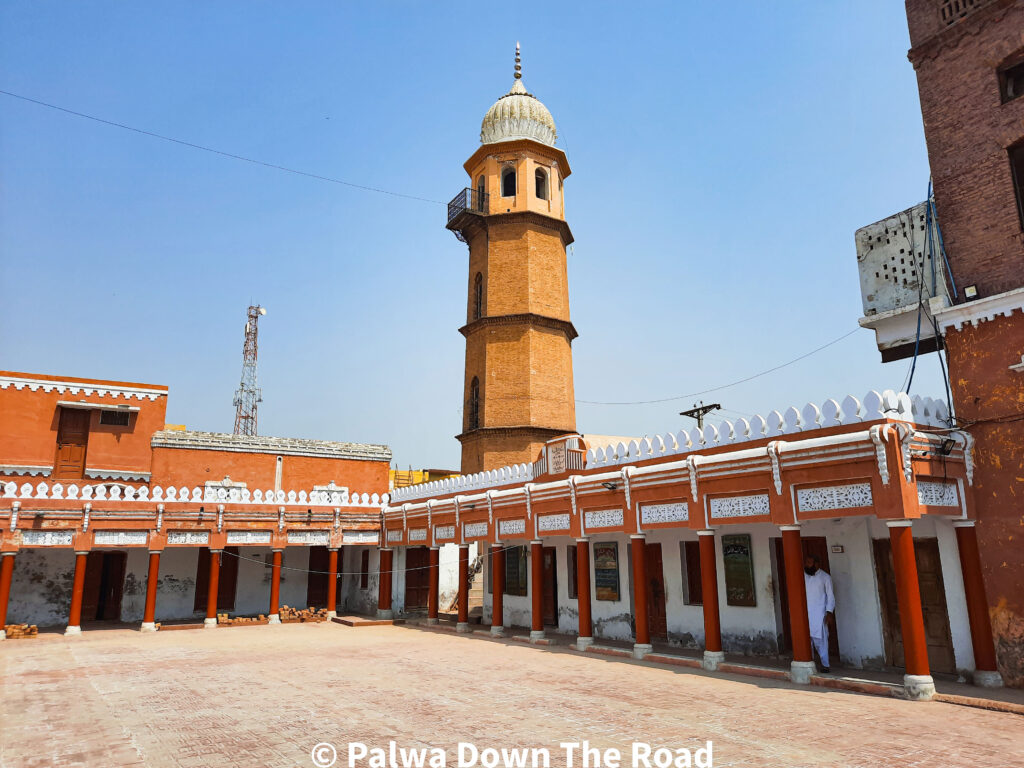
Hostel rooms, study halls, dining halls, and staff rooms are on the northern side of the courtyard. There is a historical cemetery called Khanqah-e-bugvia. The founder of the present campus and other luminary scholars and saints of the bugvia dynasty are buried here.
Interestingly, one does not find red or white marble or precious stones in the masonry work of the Masjid. The brick used in construction is small but red, rigid, and compact.
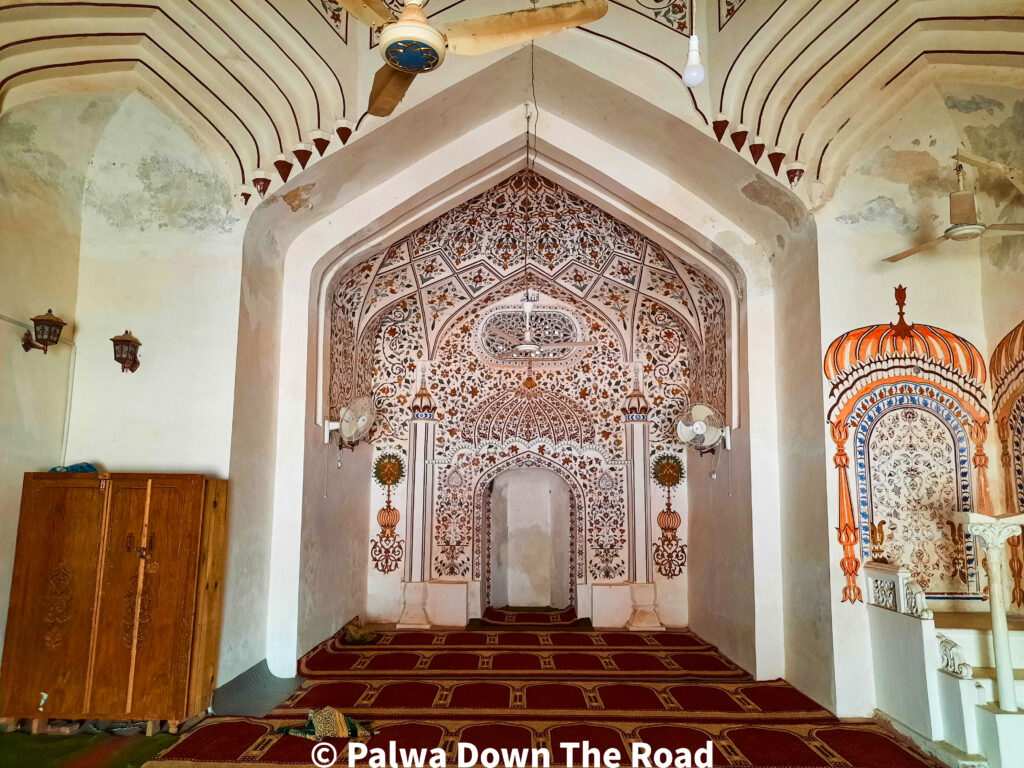
The mehraab is designed in such a way as to have proper ventilation, light, and echo-free. There is a cemented pulpit under the central dome, with three stairs and a pillar rostrum. The interior of the central dome has decorated with colorful flowers and painted with a brush. Even after more than one century, they are intact and still attractive with fading. One wonders how a master artist completed this difficult task and made lasting colors.
The bricks used in this mosque were small but strong. No red or white marble or precious stones were used during the construction of the Jamia Masjid. The mosque has three domes, and the middle dome is the biggest. The minarets of the mosque were built-in in 1905.
The courtyard is quite spacey and can accommodate thousands of devotees / praying persons. Even a masjid consists of multiple arches. Fronton is bow-shaped and covered with continuous leafy branches carrying “Allah us Samad” in flower shape and the first kalma in Nastaliq. The main entrance of the masjid is covered.
The Bhera mosque always had a central position in educational, missionary, political, and social movements. During British rule, the ulema of the mosque always guided the Muslims in their struggle for freedom and spread unity and harmony among Muslims. Continued work of education, righteousness, and guidance, free of sectarianism.
In the outer portion of the Mosque, Bhera Information and Research Centre and a library is built with original architectural design. It consisted of 300 invaluable manuscripts with a copy of Aaeen-i-Akbari and ten copies of Qur’an.
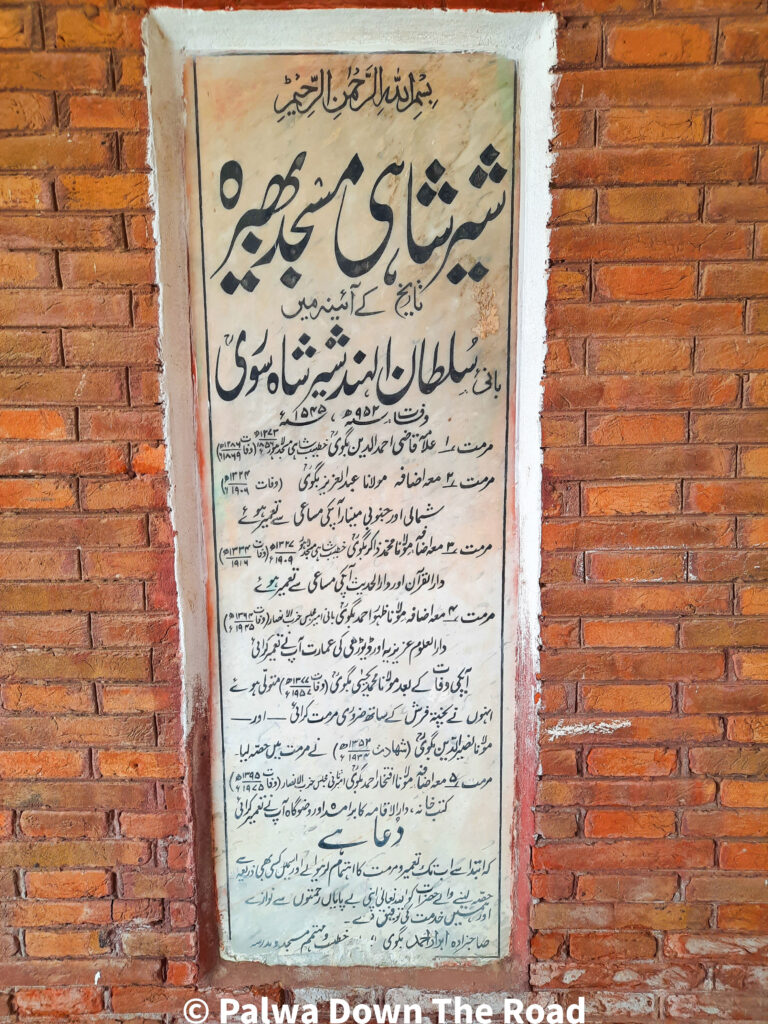
Unlike other historical or archaeological monuments, this mosque of Bhera has no royal decree, waqf attachment, or allocations. The locals look after it thru a board of trustees. The Bugvi family has many contributions to this mosque. At the same time, TDCP has made efforts to improve this mosque’s fresco and main entrance work. The coordinates of the mosque are 32° 28′ 40″ E, 72° 54′ 36″ N.
Hopefully, this blog will inspire you to visit this amazing mosque. Also, if you have any questions on Punjab or my experience traveling on a bicycle/motorbike, please comment below or email me. I’ll try to reply to you as soon as possible.