In Pakistan, there are more than 80 live mud volcanoes in the Balochistan province. In the province’s Miani Hor-Hingol Valley area, the elevations of mud volcanoes range between 800 to 1,550 feet. The most famous is Chandragup, an immense crater found at about 450 feet in diameter and is easily accessible to tourists.
Along the shore of Pakistan, the tectonic plate underlying the Arabian Sea is diving under the Eurasian continent. This process typically produces volcanoes.
If you are more of a visual person, then please watch the following video, which summarizes my Mud Volcanoes of Balochistan trip:
History of Mud Volcanoes in Balochistan
The earliest record of the appearance of mud volcanoes in Balochistan goes back to 1840.
In 1862, Major (later Sir) Frederick John Goldsmid was appointed by the Governor of Bombay for particular purposes. Goldsmid and his party initiated their journey overland from Karachi and wrote a journal of their trips up to Gwadar.
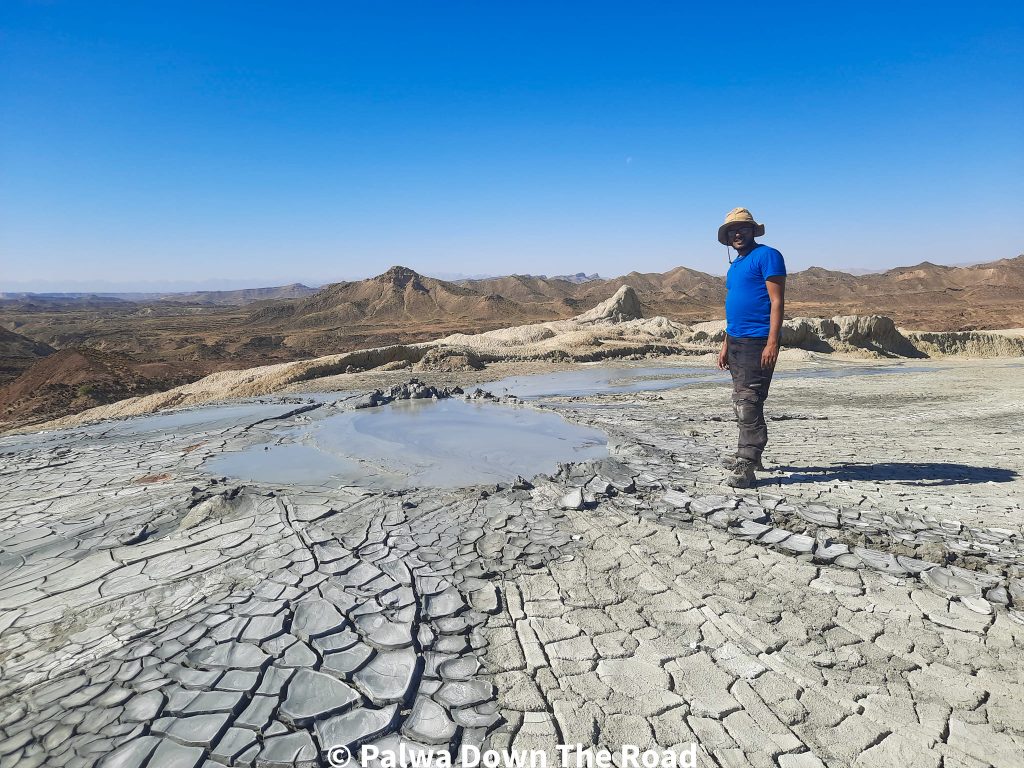
This travelogue tells about the mud volcanoes, which gives the first surviving record of their presence. In the journal, Goldsmid writes about crossing through bubbling springs near Ras Koocheri and taking roads to see the ancient Hindu temples of Hinglaj and the mud volcanoes near Ormara.
The Hindus praise these mud volcanoes as the home of the goddess Babhaknath.
During the 8.1 magnitude earthquake of Balochistan, which happened on May 31, 1935, a mud volcano emitted Northwest of Quetta, near the town of Surab. It kept spitting out mud for 9 hours continuously.
On November 28, 1945, an earthquake of 7.8 magnitudes happened in the Arabian Sea off the coast of Makran. The quake created a tsunami, with a wave reaching as high as 13m at some places, killing 4000 people off the Arabian Sea shore in Sindh and Baluchistan. In addition, widespread destruction happened in the towns of Pasni and Ormara.
This earthquake shook and vented the mud volcanoes of Hungol so much that the gases coming out of these volcanoes got ignited, and flames rose several hundred feet in the air.
The news of glowing volcanoes ejecting in Balochistan (1945) spread across India. There were also reports from RAF aircraft operating from the west of volcanic explosions in Lasbela State in Balochistan.
Another record of these volcanic eruptions comes from V.P. Sondhi. In 1947 he wrote about the same volcanic happening near the entrance of the Hingol River in Baluchistan following the 1945 earthquake.

V.P. Sondhi also documented the rise of three mud volcano islands in the Arabian Sea just off the coast of Makran. Unfortunately, these offshore mud volcanoes didn’t live long, and the decisive wave action of the Arabian Sea destroyed the marshy islands for months. At the end of 1946, these mud volcanoes were gone entirely.
The geological analysis says that the mud volcanoes arising from the Arabian Sea emerge from highly viscous mud with high gas content. The mud gets driven up by high resilience forces, and over time, a high mud hill or mountain appears out of the water.
A scientist named G. Delisle recorded in 2002, the origin of a new mud volcano island in March 1999 in nearly the same area. This time was not accompanied by an earthquake, but it was also destroyed by wave action a few months later.
Chandragup System of Mud Volcanoes
These mud volcanoes are in Hingol National Park, one of Pakistan’s most significant national parks.
Seven out of the eighteen mud volcanoes are a few kilometers from the Sapat post. However, the rest of the 11 mud volcanoes are in the west, between Kutch and Gwadar.
These are not on the main road about a kilometer off the Makran Coastal Highway leading from Lasbela to Gwadar. The region includes a group of three major mud volcanoes and several smaller ones.
Rather than lava, ash, and sulfur dioxide, these volcanoes blow mud and methane.
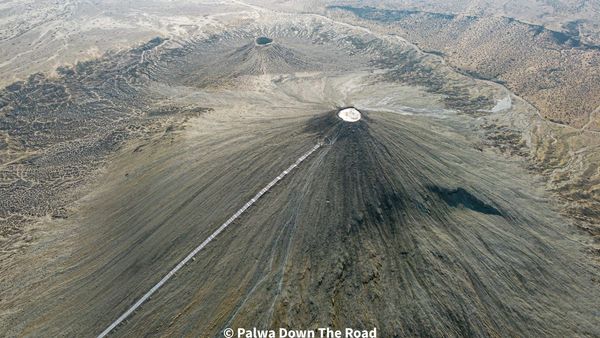
This natural-color image shows the most impressive mud volcanoes in the area, known as the Chandragup System.
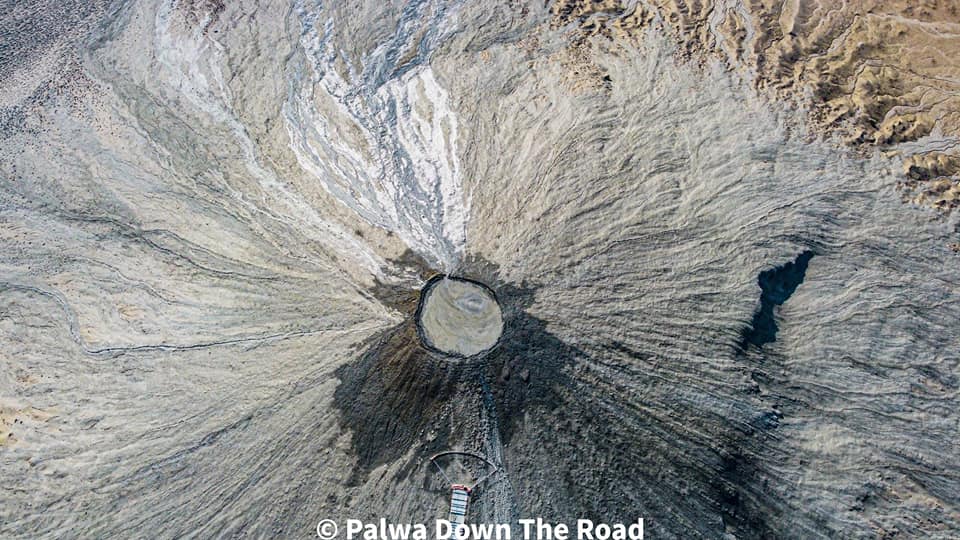
The three mud volcanoes of the area are named Chandragup1, Chandragup2, and Chandragup3.
The largest volcano, Chandragup I, is about 330 feet high. It has a 49-foot broadness mud lake in its hole that regularly overflows. A second crater appears from the southern flanks of Chandragup, but it is not currently alive.
The 150 feet of Chandragup II lies northeast of the higher cone.
Holy Site for Hindus
Chandragup I is a holy yearly pilgrimage site for Hindus, along with the Hinglaj Mata mandir.
The Chandragup mud volcano is praised as a manifestation of the Hindu god Shiva and is called Baba Chandragup. Also recognized as Chandrakup, the volcano is considered sacred by Hindus. Another word that locally states this group of volcanoes is ‘Chandra coop,’ meaning the Volcanoes of the Moon.
Pilgrims of the volcano believe that they can enter the Shri Minglaj Mata temple only after paying tribute to Baba Chandrakup.
It is a necessary stay for pilgrims on their way to the Hinglaj Mata temple.
Traditionally, the pilgrim stays up all night, fasting and thinking about the sins they will admit at the end of the following day. Then, they bake roti from ingredients contributed by all the yātrīs. The next day, they climb the slope of Chandrakup, and the roṭi is served as an offering to Baba Chandrakup.
Believers submit coconuts to the craters to make wishes and thank the gods for fulfilling their prayers.
The bubbling of mud and the reply of the wind can tell if the pilgrim’s sins are forgiven.

At the volcano’s top, the pilgrims must introduce themselves with their full name and place of birth and then call out their wrongdoings in front of the group.
People say that mud volcanoes have roots that go many kilometers underground and act as safety devices for high underground pressure.
Are Mud Volcanoes Dangerous?
Mud volcanoes are generally not supposed to be dangerous. They are a tourist attraction. However, in some countries like Azerbaijan, which has the most extensive collection of mud volcanoes worldwide, gas explosions from mud volcanoes are more common and extreme than those in Pakistan. Should Pakistan do the same?
However, one needs to be careful while walking along the sides of these mud volcanoes. For example, I fell into Chandargup mud volcano when the first time I was there. I directly stepped on the mud of the volcano.
How to Reach Mud Volcanoes in Balochistan
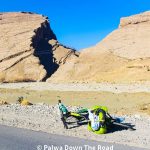
Pakistan’s Balochistan province has a distinct landscape. With the N10 – Makran Coastal Highway available in 2004, mud volcanoes in Balochistan are now within a few hours’ reach from Karachi.
To reach the most popular group of these mud volcanoes, one has to move west of Karachi on the Makran Coastal Highway (N10).
Tourism should be allowed but within a safe distance of these sandy masterpieces. I also recommend visiting these volcanoes and not mentioning the joy of travel on the scenic Coastal Highway, which deserves an entire post on its scenic route alone.
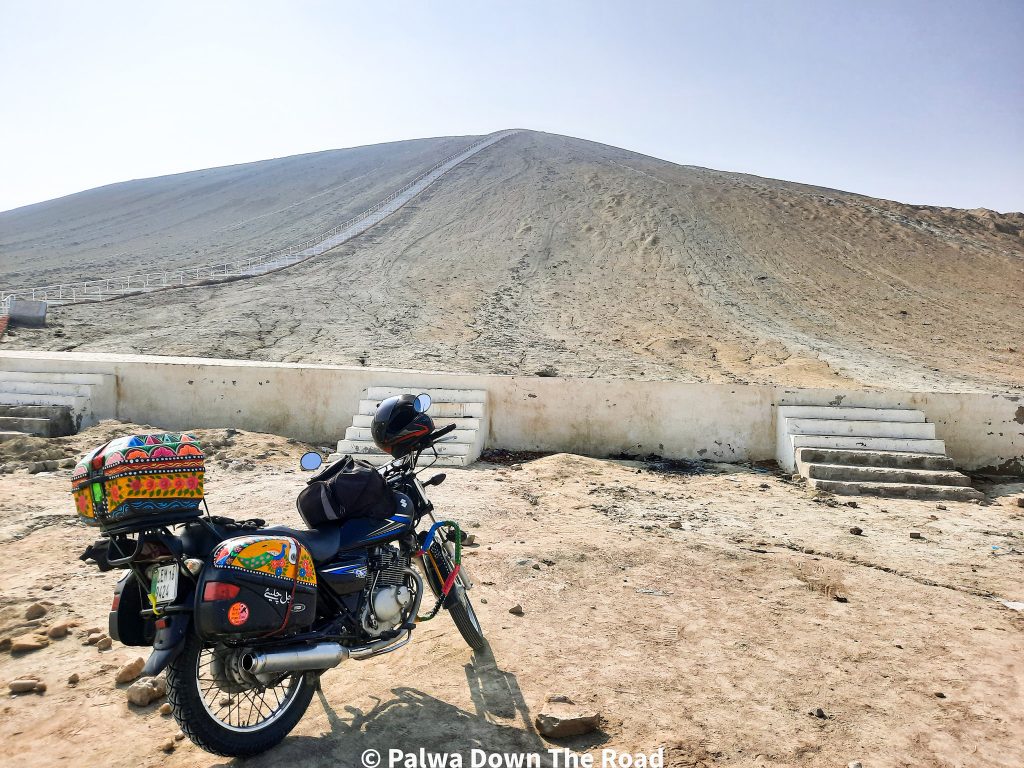
As you can see, how interesting are these mud volcanoes?
Hopefully, this blog will inspire you to visit these areas of the Makran Coastal Highway. Also, if you have any questions on Balochistan or my experience traveling on a bicycle/motorbike, please comment below or email me. I’ll try to reply to you as soon as possible.